Efficient and Safe Peptide Bond Formation Using OxymaPure DIC Coupling
OxymaPure DIC peptide coupling is widely used in peptide synthesis due to its efficiency and low racemization. This method involves the activation of the carboxyl group by DIC, followed by OxymaPure-mediated ester formation, which facilitates amide bond formation with minimal side reactions.
Traditional methods employing diisopropylcarbodiimide (DIC) alone have been associated with significant racemization of amino acids, compromising the integrity of the synthesized peptides. The introduction of additives like OxymaPure [ethyl 2-cyano-2-(hydroxyimino)acetate] has revolutionized this process by enhancing coupling efficiency and minimizing racemization.
The OxymaPure DIC combination is now widely recognized as a superior method in both solid-phase and solution-phase peptide synthesis.

| Property | OxymaPure | HOBt | 6-Cl-HOBt | HOAt |
|---|---|---|---|---|
| pKa | 4.60 | 4.60 | 3.35 | 3.28 |
| Molecular weight [Da] | 142.11 | 135.11 | 169.57 | 150.13 |
| CAS number | 3849-21-6 | 2592-95-2 | 26198-19-6 | 39968-33-7 |
For a detailed comparison and mechanistic insight into traditional benzotriazole-based additives such as HOBt and HOAt, see the companion article on the HOBt Peptide Coupling Mechanism.
📘 What will you learn here?
Mechanism of OxymaPure DIC Peptide Coupling
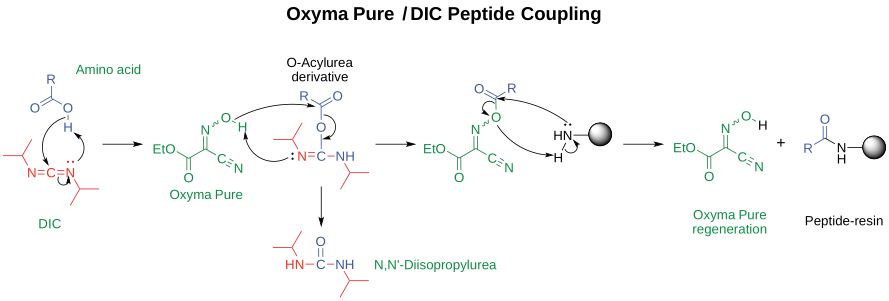
The coupling mechanism begins with the activation of the carboxylic acid by DIC, forming an O-acylurea intermediate. This intermediate is prone to side reactions, including racemization and the formation of by-products. The addition of OxymaPure addresses these issues effectively.
The anionic form of OxymaPure reacts with the O-acylurea, releasing N,N’-diisopropylurea and forming a more reactive OxymaPure ester. This activated ester readily undergoes aminolysis with the nucleophilic amine, leading to the desired amide bond formation while regenerating OxymaPure. This process not only enhances coupling efficiency but also significantly reduces racemization.
Advantages in Solid-Phase Peptide Synthesis (SPPS)
In SPPS, the OxymaPure DIC system offers several advantages over traditional methods. Notably, it provides higher coupling efficiencies and lower racemization rates compared to additives like HOBt, 6-Cl-HOBt, and HOAt, which have been associated with explosive hazards.
OxymaPure is non-explosive, making it a safer alternative without compromising performance. Studies have demonstrated its effectiveness in both manual and automated peptide synthesis, including microwave-assisted protocols. Furthermore, OxymaPure exhibits high solubility in common peptide synthesis solvents, facilitating its integration into various synthetic workflows. Moreover, OxymaPure plays an important role in preventing aspartimide side reaction.
Considerations Regarding Hydrogen Cyanide Formation
Recent studies have reported that the reaction between OxymaPure and DIC can generate trace amounts of hydrogen cyanide (HCN). While the quantities are minimal, appropriate safety measures should be implemented to mitigate any potential risks.
It is advisable to conduct couplings in well-ventilated areas and consider the use of scavengers or alternative solvents to minimize HCN formation. Additionally, the technique to scavenge the generated HCN with DMTS was reported, as well as the solvents in which this reaction is slowed down.
Despite this consideration, the benefits of using OxymaPure DIC in peptide synthesis remain substantial, provided that standard laboratory safety protocols are followed.
Sustainability and Solvent Compatibility in OxymaPure DIC Peptide Coupling
Regulatory pressure on N,N-dimethylformamide (DMF) and N-methyl-2-pyrrolidone (NMP), driven mainly by reproductive toxicity concerns under REACH, has increased interest in safer solvent systems for solid-phase peptide synthesis (SPPS). While these solvents remain widely used, many laboratories are actively evaluating alternatives within “green SPPS” frameworks. OxymaPure supports this transition by enabling efficient carbodiimide-mediated couplings under less aggressive solvent conditions, without increasing racemization or side reactions.
Performance in Alternative Solvents
2-Methyltetrahydrofuran (2-MeTHF)
This biomass-derived ether is one of the most validated alternatives to DMF in SPPS. Studies show that DIC/OxymaPure systems in 2-MeTHF provide high coupling efficiency with low racemization in a range of model and practical peptide syntheses, approaching the performance observed in conventional DMF-based protocols.
γ-Valerolactone (GVL)
GVL is a biodegradable, high-boiling solvent derived from renewable sources. Its use in SPPS remains exploratory. OxymaPure-based coupling systems show chemical stability under elevated temperatures, making GVL a potential candidate for specialized or microwave-assisted applications, provided sequence- and resin-specific compatibility is confirmed.
Binary solvent systems
Polarity-tuned mixtures such as DMSO/ethyl acetate or anisole/DMSO have been investigated to reduce toxicity while maintaining resin swelling. OxymaPure exhibits adequate solubility and reliable coupling performance in these environments, often matching or improving upon benzotriazole-based additives under comparable conditions.
Conclusion
The OxymaPure DIC coupling system stands out as an efficient and safer alternative for peptide bond formation, addressing the challenges of racemization and hazardous by-products associated with traditional methods. Its application in both solid-phase and solution-phase peptide synthesis has been well-documented, offering high yields and purity. Ongoing research continues to optimize its use and explore new derivatives to further enhance peptide synthesis methodologies.
For readers interested in the mechanistic foundation and historical development of earlier (benzotriazole) systems, see the companion article on the HOBt and HOAt Peptide Coupling Mechanism, which explains how these additives established the framework that OxymaPure now advances.
OxymaPure DIC Peptide Coupling — FAQ
OxymaPure DIC coupling offers a highly efficient method for forming peptide bonds. It combines DIC as an activator with OxymaPure as an additive. Consequently, this pairing delivers superior yields and minimizes racemization more effectively than using DIC alone.
The process follows three clear stages: 1. Activation: First, DIC reacts with the carboxylic acid to form an O-acylurea intermediate. 2. Ester Formation: Next, the OxymaPure anion transforms this intermediate into a reactive active ester. 3. Aminolysis: Finally, the incoming amine attacks the ester to form the peptide bond and regenerate the catalyst.
Traditional benzotriazole additives like HOBt are explosive, which complicates storage and handling. In contrast, OxymaPure is non-explosive. Therefore, it provides a safer alternative for both laboratory and industrial-scale synthesis.
Yes. Beyond reducing general racemization, OxymaPure successfully prevents aspartimide formation. This specific side reaction often disrupts Solid-Phase Peptide Synthesis (SPPS) during aspartic acid sequencing.
While non-explosive, the reaction can generate trace hydrogen cyanide (HCN). To manage this, always work in well-ventilated fume hoods. Furthermore, using scavengers like DMTS or specific solvents can capture any generated HCN.
Absolutely. Because OxymaPure dissolves readily in solvents like DMF, it integrates seamlessly into manual, automated, and microwave-assisted protocols.
Microwave synthesis accelerates coupling times to just a few minutes. OxymaPure excels here because the OxymaPure/DIC pairing remains stable at temperatures up to 90°C. Furthermore, it provides a non-explosive alternative to HOBt, ensuring safety during the rapid heating cycles of a microwave reactor.
References
Development and Mechanism of OxymaPure in Peptide Coupling
Subirós-Funosas, R., Prohens, R., Barbas, R., El-Faham, A., Albericio, F. (2009). Oxyma: An efficient additive for peptide synthesis to replace the benzotriazole-based HOBt and HOAt with a lower risk of explosion. Chemistry – A European Journal, 15(37), 9394-9403.
- Introduces OxymaPure as a safer alternative to HOBt and HOAt, with high coupling efficiency and minimal racemization.
- DOI: 10.1002/chem.200900614
El-Faham, A., Albericio, F. (2011). Peptide coupling reagents, more than a letter soup. Chemical Reviews, 111(11), 6557-6602.
- A comprehensive review of various peptide coupling reagents, including OxymaPure, discussing efficiency and safety considerations.
- DOI: 10.1021/cr100048w
Montalbetti, C.A.G.N., Falque, V. (2005). Amide bond formation and peptide coupling. Tetrahedron, 61(46), 10827-10852.
- A detailed review of amide bond formation methodologies, including carbodiimide-based couplings.
- DOI: 10.1016/j.tet.2005.08.031
Itoh, M. (1973). Peptides. IV. Racemization Suppression by the Use of Ethyl 2-Hydroximino-2-cyanoacetate and Its Amide. Bulletin of the Chemical Society of Japan, 46(7), 2219-2221.
- One of the first studies highlighting the use of Oxyma (ethyl 2-cyano-2-(hydroxyimino)acetate) for racemization suppression.
- DOI: 10.1246/bcsj.46.2219
Safety and Hazardous Properties of Traditional and New Coupling Reagents
Wehrstedt, K.D., Wandrey, P.A., Heitkamp, D. (2005). Explosive properties of 1-hydroxybenzotriazoles. Journal of Hazardous Materials, 126(1-3), 1-7.
- Examines the hazardous properties of traditional benzotriazole-based coupling reagents like HOBt and HOAt, justifying the need for safer alternatives like OxymaPure.
- DOI: 10.1016/j.jhazmat.2005.05.044
Erny, M., Lundqvist, M., Rasmussen, J. H., Ludemann-Hombourger, O., Bihel, F., & Pawlas, J. (2020). Minimizing HCN in DIC/Oxyma-Mediated Amide Bond-Forming Reactions. Organic Process Research & Development, 24(7), 1341–1349.
- Investigates the formation of hydrogen cyanide (HCN) during DIC/Oxyma-mediated amide bond-forming reactions and proposes methods to minimize its occurrence by altering solvent compositions and employing in situ scavengers.
- DOI: 10.1021/acs.oprd.0c00227
McFarland, A.D., Buser, J.Y., Embry, M.C., Held, C.B., Kolis, S.P. (2019). Generation of Hydrogen Cyanide from the Reaction of Oxyma (Ethyl Cyano(hydroxyimino)acetate) and DIC (Diisopropylcarbodiimide). Organic Process Research & Development, 23(9), 2099-2105.
- Investigates the potential HCN generation when using Oxyma/DIC, emphasizing safety precautions.
- DOI: 10.1021/acs.oprd.9b00344
Jad, Y. E., Acosta, G. A., Khattab, S. N., de la Torre, B. G., & Albericio, F. (2016). 2-Methyltetrahydrofuran as a green solvent for solid-phase peptide synthesis. ACS Sustainable Chemistry & Engineering, 4(12), 6809–6814.
- Experimental study demonstrating the feasibility of replacing DMF with 2-MeTHF in selected SPPS protocols, including evaluation of resin swelling, coupling efficiency, and peptide purity.
- DOI: 10.1021/acssuschemeng.6b01765
Applications of OxymaPure in Peptide Synthesis and Beyond
Collins, J.M., Porter, K.A., Singh, S.K., Vanier, G.S. (2014). High-Efficiency Solid Phase Peptide Synthesis (HE-SPPS). Organic Letters, 16(3), 940-943.
- Discusses modern high-efficiency peptide synthesis methods, including improved coupling protocols.
- DOI: 10.1021/ol4036825
Manne, S.R., El-Faham, A., Albericio, F. (2020). OxymaPure Coupling Reagents: Beyond Solid-Phase Peptide Synthesis. Synthesis, 52, A–U.
- Reviews recent advances in amide bond formation using OxymaPure, including applications outside of solid-phase peptide synthesis.
- DOI: 10.1055/s-0040-1706296
Ma, Y., Liu, Y., Wang, J., Chen, X., Yin, H., Chi, Q., Jia, S., Du, S., Qi, Y., Wang, K. (2022). DIC/Oxyma-Based Efficient Synthesis and Activity Evaluation of Spider Peptide Toxin GsMTx4. Chinese Journal of Organic Chemistry, 42(2), 498-506.
- Highlights DIC/Oxyma’s high efficiency, low cost, operational safety, and reduced racemization rate in peptide synthesis.
- DOI: 10.6023/cjoc202109003
Palakurthy, N.B., Dev, D., Rana, S., Nadimpally, K.C., Mandal, B. (2013). Sulfonamide synthesis via oxyma-O-sulfonates – Compatibility to acid-sensitive groups and solid-phase peptide synthesis. European Journal of Organic Chemistry, (13), 2627-2633.
- Explores Oxyma-based reagents beyond peptide coupling, showing broader applications in organic synthesis.
- DOI: 10.1002/ejoc.201201571
Advances in Peptide Coupling Reagents and Structural Considerations
Taylor, P., Albericio, F., Chinchilla, R., Dodsworth, D. J. (2001). New Trends in Peptide Coupling Reagents. Organic Preparations and Procedures International, 33(3), 203–313.
- Provides a comprehensive review of advancements in peptide coupling reagents, offering context for the development and adoption of OxymaPure in peptide synthesis.
- DOI: 10.1080/00304940109356592
Subirós-Funosas, R., El-Faham, A., Albericio, F. (2012). Use of Oxyma as pH Modulatory Agent to Be Used in the Prevention of Base-Driven Side Reactions and Its Effect on 2-Chlorotrityl Chloride Resin. Peptide Science, 98(2), 89-97.
- Demonstrates that Oxyma effectively suppresses base-driven side reactions such as aspartimide formation and proline overcoupling while maintaining compatibility with acid-sensitive resins like 2-chlorotrityl chloride resin.
- DOI: 10.1002/bip.21713
Azev, Y. A., Mokrushina, G. A., Postovskii, I. Ya., Sheinker, I. N., Anisimova, O. S. (1976). Structure and Properties of 1- and 3-Hydroxytriazolo[4,5-b]pyridines. Chemistry of Heterocyclic Compounds, 12(10), 1172–1176.
- Investigates the structural and property differences between 1- and 3-hydroxytriazolo[4,5-b]pyridines, providing insights into the design of safer and more efficient coupling additives.
- DOI: 10.1007/BF00945609
El-Faham, A., Al Marhoon, Z., Abdel-Megeed, A., Albericio, F. (2013). OxymaPure/DIC: An Efficient Reagent for the Synthesis of a Novel Series of 4-[2-(2-Acetylaminophenyl)-2-Oxo-Acetylamino] Benzoyl Amino Acid Ester Derivatives. Molecules, 18(12), 14747–14759.
- Demonstrates the application of the OxymaPure/DIC system in synthesizing complex amino acid derivatives, highlighting its efficiency and versatility beyond standard peptide coupling.
- DOI: 10.3390/molecules181214747